
The Office Building That Knows How You Take Your Coffee
The EDGE in AMsterdam
The Edge in Amsterdam's Zuidas district produces more energy than it uses, remembers your coffee order, and earned the highest green building score ever recorded.
It knows what car you drive.
It knows who you’re meeting with today.
And yes — it knows how you take your coffee. At least, once you’ve told it.
This is the Edge, a 14-story office building in Amsterdam’s Zuidas business district. Completed in 2014 and designed by PLP Architecture for developer EDGE Technologies, it houses the Amsterdam headquarters of consulting firm Deloitte alongside tenants including AKD and Sandvik. Its gross floor area is 40,000 square meters, it has 372 parking spaces, and it earned a BREEAM-NL sustainability score of 98.36% — the highest ever awarded by the British rating agency, and a record that has not been broken since. It’s darn impressive. And it is a beautiful space to work too.

What It’s Like to Arrive at the EDGE
A day at the Edge starts before you get there. The building’s smartphone app — developed with Deloitte — checks your schedule in the morning and begins preparing for you. When you drive into the garage, a camera reads your license plate, matches it against the employment database, and raises the gate. The overhead lights — sensor-equipped LEDs — brighten as you approach your parking space and dim as you walk away.
This is not a gimmick (albeit maybe a little Big Brother creepy). It is the building managing its own energy use in real time, one small decision at a time.
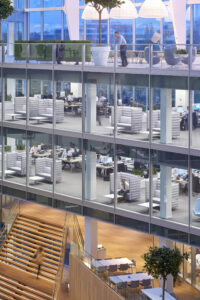
Inside, there are no assigned desks. Not for anyone. The 2,500 Deloitte employees who work in the Edge share approximately 1,000 workspaces — a model called hot desking, built on the Dutch philosophy of het nieuwe werken, or “the new way of working.” The idea is that fixed locations and fixed routines produce fixed thinking. Move people around, break the pattern, and something more useful might happen.
The app finds you a desk based on your schedule for the day. Sitting desk, standing desk, work booth, concentration room, meeting room, balcony seat — it knows what you have coming up and assigns accordingly. Lockers serve as home base: find one with a green light, tap your badge, and it’s yours. Employees are encouraged not to keep the same locker across multiple days, for the same reason they don’t have the same desk.
What the Building Is Actually Doing
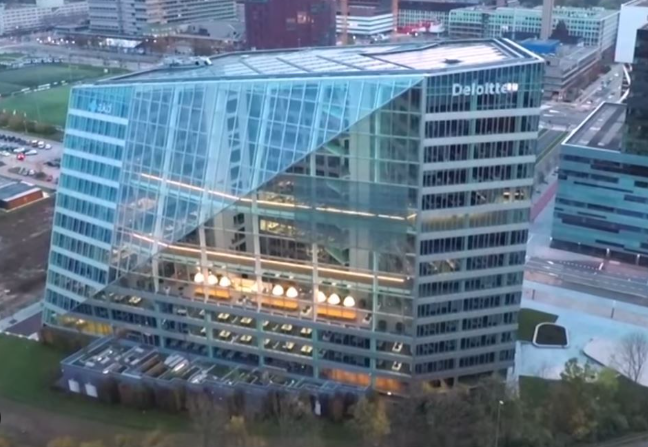
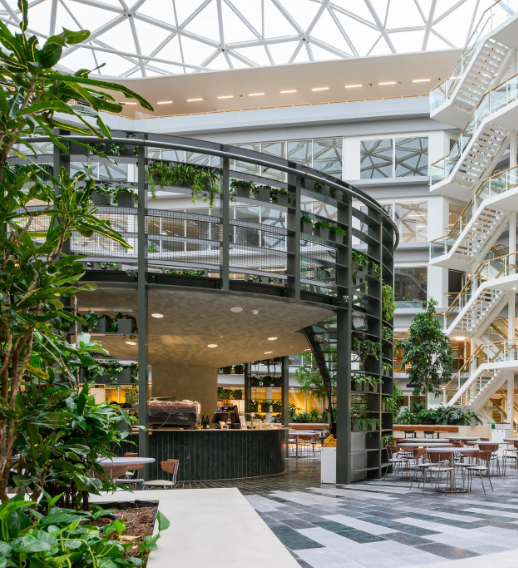
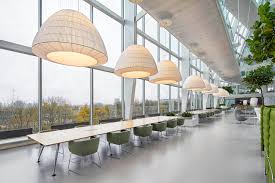
The atrium is where most of this becomes visible. It runs the full height of the building, and the shape of the Edge — from outside, it looks like a standard glass office block with a triangular wedge sliced cleanly off one corner — is designed specifically to flood that atrium with daylight from the south. Every workspace in the building sits within 7 meters (23 feet) of a window. On a gray Dutch morning, the interior reads as genuinely luminous rather than lit.
The atrium does more than carry light. Mesh panels between each floor allow stale office air to spill into the open space, rise naturally, and be expelled through the roof. The system creates a loop of passive ventilation that keeps the interior feeling more like the outdoors than a climate-controlled box. Slight heat variations and air currents move through the space in ways that a sealed building cannot replicate.
Underneath all of this, the energy systems are doing something that took genuine engineering to achieve. In summer, the building pumps warm water more than 400 feet down into the aquifer beneath the site, where it sits insulated until winter. When temperatures drop, the stored water is retrieved and used for heating. EDGE Technologies describes this as the most efficient aquifer thermal energy storage system in the world. Whether or not that claim holds indefinitely, the result is measurable: the Edge uses 70% less electricity than a comparable office building.
The southern wall is a checkerboard of solar panels and windows — 6,000 square meters of panels in total, across the roof and facades. The panels provide energy and simultaneously reduce solar radiation entering the building, which reduces the cooling load. Thick load-bearing concrete moderates temperature fluctuations. Deeply recessed windows eliminate the need for blinds even in direct sunlight. The building was only able to claim net energy-positive status after EDGE installed additional panels on the rooftops of neighboring university buildings — a detail worth knowing, and one the building’s own documentation does not hide.
28,000 Sensors and a Dashboard
The Edge contains 28,000 sensors. They track occupancy, temperature, humidity, light levels, and energy use across the entire building in real time. The data feeds into a central dashboard that gives facilities teams a live view of how the building and its occupants are interacting. On days when fewer people are expected, entire sections can be shut down — heating, cooling, lighting, and cleaning suspended until needed. Nothing runs on assumption. No cleaning crews are vacuuming meeting rooms that haven’t been used that day.
The hot drink machines remember how you take your coffee, or tea. Flatscreens throughout the building sync wirelessly with any phone or laptop. Every desk has a built-in wireless charger. If you want to order groceries, the app can handle that too: request a dinner recipe during the day, and a bag of fresh ingredients will be waiting when you leave.
PLP Architecture, the firm that designed the building, framed the central question of the project this way: “What is the role of architecture when the workplace is permeated by layers of technology that fundamentally alter the way that we interact with our environment?” Their answer was a building that makes informal collaboration visible, creates multiple distinct working atmospheres, and treats flexibility — physical and digital — as the organizing principle rather than an afterthought.
There are also bee nests on the roof. The building’s ambitions, it turns out, extend to local pollinators.
How to See It
The Edge is a working office building and is not open to general visitors. The exterior, however, is visible from the street and is worth a detour if you are in the Zuidas district of Amsterdam. The building’s distinctive wedge profile — that triangular cut from the south-facing corner — is identifiable from a distance, and the southern wall’s checkerboard of solar panels and glass reads clearly from the street.
Traveler note: Zuidas is about 20 minutes from Amsterdam Centraal by metro or tram. The Edge sits at Gustav Mahlerplein 5. The surrounding district has other notable architecture worth a walk, and the area is easy to combine with a visit to the Rijksmuseum or Vondelpark, which are a short tram ride away.
How This Fits the Earth Day Series
In part one of this series, we looked at Bosco Verticale in Milan — two residential towers that carry approximately 900 trees on their balconies as a direct response to the loss of green space in dense cities. The argument there is visible and emotional: you can see the forest from the street.
The Edge makes a different kind of argument. There is no forest on the facade. Nothing here is designed to make you feel something from the sidewalk. The sustainability at the Edge is almost entirely invisible — 400 feet underground in an aquifer, embedded in 28,000 sensors, moving through mesh panels in an atrium. It works because of the intelligence of the systems, not because of how it looks.
Both are legitimate answers to the same question: how do we build better? One makes the answer visible. The other makes the answer work.
Have you visited a building that made you think differently about what architecture can do? I’d love to hear about it in the comments.
Books Before Boarding
If you’d like to dig a little deeper into the structure of the EDGE, I recommend the following architectural anthology:
Amsterdam Architecture City: The 100 Best Buildings (Paul Groenendijk & Peter de Winter): The latest editions of this essential guide include The Edge as a modern marvel in the Zuidas business district. It’s a great resource for seeing how the building fits into the broader historical and modern context of Amsterdam’s skyline.