
Five Days in Jordan:
Petra, Wadi Rum & Amman
An adventure for the solo woman traveler by one who went in curious and came home changed.
I want to tell you about the moment the Treasury of Petra appeared. I'd seen photographs of it my whole life. I had watched Indiana Jones embarrass the Nazis right there in that canyon. And I still wasn't ready for it. One second you're walking through a narrow slot of rock, the walls close and cool and smelling faintly of stone and dust — and then the canyon bends, and there it is, perfectly framed, impossibly detailed, carved straight into the rose-red cliff face. I actually laughed. It's that kind of moment.
If you're looking for a trip that makes your legs ache, your sense of time collapse, and your camera fill up faster than you expect, Jordan is it. My five days covered Amman, Petra, and Wadi Rum, and I came home with the conviction that this is one of the world's great journeys for women who travel solo. Here's how it went, and how you can make it even better.
One second you’re walking through a narrow slot of rock — and then the canyon bends, and there it is.
Day 1 — Amman: City of Hills, Good Coffee, and Layers of History
I arrived in Amman the way you probably will: bleary, carrying too much, and already recalibrating my sense of distance. Amman is built on hills — seven of them originally, dozens now as the city has expanded — and each road rolls and climbs. You can’t walk anywhere in a straight line for long.
I flew in, dropped my bag at the hotel, and got outside before the day slipped away. Five days is hardly enough, but it was all I had on this trip.
Before I get into the days themselves, a quick bit of anchoring: Petra was a Nabataean capital built on trade and water control (made famous to the western world thanks in part to Indiana Jones and the Temple of Doom). Wadi Rum is the wider desert system surrounding it. UNESCO ties Petra to its carved sandstone architecture and water engineering, and Wadi Rum to its geology and a human record going back at least 12,000 years. I kept coming back to that context throughout the trip. It gave meaning to what I was looking at instead of letting it all blur into a checklist.
To give myself some of that grounding before heading south to the desert from Amman, I spent part of the afternoon at the Jordan Museum — the country’s largest archaeological and historical museum, located in the Ras al-Ain neighborhood. It traces Jordan’s human story from the prehistoric period through the modern era, and includes artifacts from Petra, Wadi Rum, and the wider region. Walking through it before seeing the sites themselves made everything I encountered over the following days more legible. I’d recommend it for anyone who wants context before stepping into Petra’s canyon.
After the museum, I made my way to Rainbow Street in Jabal Amman. It has an artsy neighborhood feel with small restaurants, bookshops, women in everything from abayas to jeans, and street art on walls between the stone buildings. On Fridays, the street also hosts an outdoor market. Sadly, I missed it. But I DID find some excellent coffee, and that, my friend, can make all the difference in the world. Even better, it was inside a bookstore! Books@Cafe is a bohemian bookstore/cafe/restaurant and “legendary Amman institution” with one of the best terraces in the city for sweeping views of downtown Amman.
Solo tip: Amman is generally very safe for women travelers. Dress modestly — loose pants or a midi skirt, sleeves, nothing tight or low-cut — and you’ll move through the city comfortably. You’ll blend in better than you might expect, and you’ll get treated like a visitor who came to understand the place, not photograph it from a distance.
Day 1, late afternoon — The Road South: Amman to Wadi Musa
I took a minivan shuttle for the drive from Amman down to Wadi Musa — the town right outside Petra’s entrance — about three hours south. You could take a JETT bus and it gets you there, but the drive through the desert plains and into the sandstone highlands is worth having a window to yourself. The landscape shifts several times. You’ll want to watch it. The shuttle also had the A/C blasting, which probably has its benefit when the mid-day sun is streaming through the window, but I was happy to have a scarf and a light layer on hand to fend off the chill.
Wadi Musa is a service town, not a destination. It exists to feed, house, and shuttle the people who come for Petra. There are many hotel options here to choose from, and they are all very close to Petra entrance. I stayed at the Mövenpick, which sits right at the entrance to the archaeological site — close enough that I could be at the Visitor Center the moment it opened without any logistical drama.
Worth it.
I was at the gate at 6:30 the next morning. I cannot overstate how much this matters. The first hour in Petra, before the tour groups arrive, is a different experience entirely.
Day 2 — First Full Day in Petra: The Treasury, the Tombs, and Everything People Miss
Here is the thing about Petra that nobody tells you: it is enormous. Most first-timers budget a day and feel vaguely cheated that they couldn’t see it all. Give it two days. The entry pricing practically begs you to — one day costs 50 JD (about $70 USD), two days costs 55 JD (about $78 USD). That extra five dinars is the best money you’ll spend.
I secured a licensed guide at the Visitor Center before setting out. Guides are available right there on arrival, at posted prices, which meant no negotiating deeper into the site when I was already tired and distracted. It gave me a clean start and a clear number. I’d recommend doing the same. And the guides can not only tell you stories during “dead zone” periods (such as walks through the Siq or between typical highlights) but also answer questions about cultural, historical, and even culinary topics not related to Petra. My guide told me about a restaurant in Amman that I visited on my last day, as well as JETT bus schedules and tips during our walking time.
The walk from the Visitor Center to the main city area is about 3.9 kilometers (just under 2.5 miles). You’ll pass the Djinn Blocks — strange, massive carved cubes that nobody is entirely sure about — the Obelisk Tomb, and the remnants of an ancient dam system. Then you enter the Siq.
The Siq is the narrow canyon that leads you in. The walls are 80 meters (260 feet) high in places and close enough that you walk in their shadow most of the way. It bends and curves and keeps you from seeing what’s coming. This was, for centuries, one of the most defensible trade routes in the ancient world. The Nabataeans — the people who built Petra, a civilization that ran on commerce and extraordinary water engineering — chose this location deliberately, right at the hub of trade routes between Arabia, Asia, and the Mediterranean.
Keep your eyes open in the Siq for betyls — carved stone blocks or pillars that the Nabataeans used to represent their gods. They look like blank shrines set into the rock face, and they’re easy to walk past. Once you know to look for betyls throughout the site, you’ll find them everywhere — in carved niches, along processional routes, in funerary contexts. They may look blank, but they’re not.
Just before the Treasury reveal, there’s a set of prominent betyls carved high into the rock. Everyone is already straining forward for their first glimpse of the Treasury, and walks right past them. Slow down for thirty seconds and look up.
And then the canyon bends one final time, and the Treasury is there.
The Treasury — al-Khazneh — is the monument on every poster, in every travel magazine. It is 43 meters (141 feet) tall. It was carved, not built, directly into the sandstone cliff face, probably in the first century AD. It is so much more detailed in person than it appears in photographs, and it was so much better preserved than I expected. Stand there a while. Don’t rush it. Oh, and while this structure is called “the Treasury” it did not contain anything Indiana Jones might have come hunting for. It was most likely a tomb.
Let’s pause here for a little architectural deep dive into the “how” and “why” of Petra’s carved structures (you know how much I love this part!)
Petra’s builders, the Nabataeans, chose to carve rather than construct for reasons that were equal parts practical and brilliant. Sandstone, unlike quarried stone, doesn’t need to be hauled. You work with what the landscape gives you, and the landscape here gave them canyon walls hundreds of feet tall. Carving also meant no mortar, no joints, no seams to fail — a carved facade is monolithic, essentially one continuous piece of rock. It doesn’t shift, settle, or tumble in an earthquake the way a stacked structure can. But there was something strategic in it too: a city that grows inward, into the rock rather than outward across open ground, is a city that’s harder to burn, harder to raze, harder to erase. The Nabataeans were traders first, and they understood that a city is also an asset — one worth protecting. What looks like art from the outside is, from the inside, an act of permanence.
And the how? The how is just as remarkable as the why. The Nabataean craftsmen worked from the top down — beginning at the roofline and cutting downward toward the ground. This is counterintuitive if you think of building the way we usually do, from foundation up, but it makes perfect sense when you’re removing material rather than adding it. Starting at the top meant the scaffolding could be dismantled progressively as the work descended, and the finished upper sections were never put at risk by the work happening below. To achieve the proportions you see — the symmetrical columns, the precisely centered doorways, the decorative cornices that run arrow-straight across uneven cliff faces — the craftsmen used a grid system, scoring a measured network of lines into the rock surface before the detailed carving began. Those guidelines let them transfer a design, likely drawn at small scale on papyrus or clay, onto a canvas that could be forty or fifty feet high. The precision this required, without lasers or levels, is quietly staggering when you’re standing in front of the Treasury trying to find a flaw in the symmetry.
The sandstone itself was a willing collaborator. Freshly exposed Petra sandstone is relatively soft — workable with iron chisels and wooden mallets, forgiving enough to allow fine detail work. But once it meets air and light, it begins to harden through a process of natural cementation, the minerals in the rock slowly locking together as moisture evaporates from the surface. What was carvable becomes durable. The Nabataeans didn’t just choose this rock because it was there — they understood its properties, understood that the act of carving was also the act of preservation. Two thousand years later, you can still read the chisel marks.
OK, let’s continue on our tour…
Just past the Treasury you’ll find restrooms and a small restaurant — a good stop before you continue into the complex. Take it. The site is huge, and there’s no good reason to push past this point without a water refill and a moment off your feet.
Past the Treasury, the site keeps going: the Street of Facades, the Roman Theatre, the Colonnaded Street, and the Qasr al-Bint temple. That last one is not carved from rock — it was built, freestanding, which actually signals how significant it was, and honored the Nabataean chief deity, Dushara, whose name means Lord of the Mountains.
As you continue toward the Street of Facades and the main city area, you’ll find refreshment stands selling juice, water, and packaged snacks, along with occasional shaded seating. Down in the basin area there’s a larger restaurant and functional restrooms. We are in an archaeological site, so ‘functional’ is the word — but it’s there when you need it.
From the basin, I decided to head toward the Royal Tombs first, saving the Monastery climb for Day two. Walk back down the main trail toward the Colonnaded Street, continue past Qasr al-Bint and the Theatre, and as the valley opens up look to your left — the north side. The massive facades of the Royal Tombs are carved right into the cliff. From the basin it’s about half an hour at a relaxed pace on mostly flat terrain. The sweeping view over the valley from up there is one of the best in Petra. Dark black holes dotted every rock wall within sight. Miles and miles of sandstone rocks held enough hidden housing to hold thousands. Without written documents from the time, however, the exact function of each building and carving remains a mystery.
From the Royal Tombs, find the Urn Tomb — the first and largest of the group. From its terrace, follow the path back down the stairs to the main valley floor, rejoin the Street of Facades, and turn left toward the Theatre. The trailhead for the High Place of Sacrifice is just before the Theatre on your right-hand side — about 10 to 15 minutes from the Tombs. Look for the signpost, a souvenir stall, some port-a-potties, and a stone staircase cut into the rock.
It’s a steady, well-marked climb — about 45 to 60 minutes up — past carved niches and betyls and small altars, to sweeping views as you gain elevation. At the top there’s an altar platform and two obelisks. One of the best vantage points over the whole site.
Coming down, I took the Wadi Farasa loop instead of retracing my steps. You can descend the same way in about 30 to 40 minutes, but the loop through the back side of the canyon is gorgeous and eventually returns you to the Qasr al-Bint area. This is the Petra that doesn’t make the highlight reel, and it might have been my favorite part of the whole trip. Long, quiet stretches with almost no crowds — a mix of tight sandstone alleys that suddenly open into terraces and carved staircases. It’s dense with structures most visitors never see: the Garden Triclinium, the Roman Soldier Tomb (crisp geometry, surprisingly vivid detail), the Renaissance Tomb, the Broken Pediment Tomb, and the Lion Monument marking an ancient water channel.
Don’t miss: The Wadi Farasa loop down from the High Place of Sacrifice. People who walk it often say it was the best part of their visit — quieter, more intimate, and completely different in feel from the main valley.
After exiting through the Siq and back to the Visitor Center, I didn’t go straight to the hotel. About five minutes from the Visitor Center toward Wadi Musa, on the left side of the road, there’s a cluster of Bedouin-style tents — cultural tents where you can stop for tea, watch demonstrations of bread baking and desert survival skills, and browse handicrafts. Entry is 2 JD (about $3 USD). I ducked into the low entrance of one and found myself on a cushion with a glass of hot, sweet mint tea, surrounded by patterned rugs and the smell of cardamom coffee and dusty rugs. My body didn’t realize how much it needed to sit down until it did. I picked up a few beaded bracelets from some vendors and stayed longer than I planned.
Dinner that night was on the Mövenpick terrace. Five-star quality from the food to the service to the atmosphere. A true delight. I sat outside until the stars came up. Chatting with other guests, I heard about the elaborate and quite amazing breakfast buffet spread they offer here— something to consider if you have time in the morning.
Day 3 — Monastery Morning, the Photo Worth Earning, and On to Wadi Rum
Petra gives you enough on the first day to make you want more. I woke up sore. I went back anyway.
Day two is for the Monastery. From the main city area, it’s about 1.6 kilometers (1 mile) with roughly 800 steps. The official guidance calls it moderate. It felt steady and doable, not brutal. Every few minutes the path opens into a small terrace where you can catch your breath and watch the valley sink away below you. Take it at whatever pace you need to.
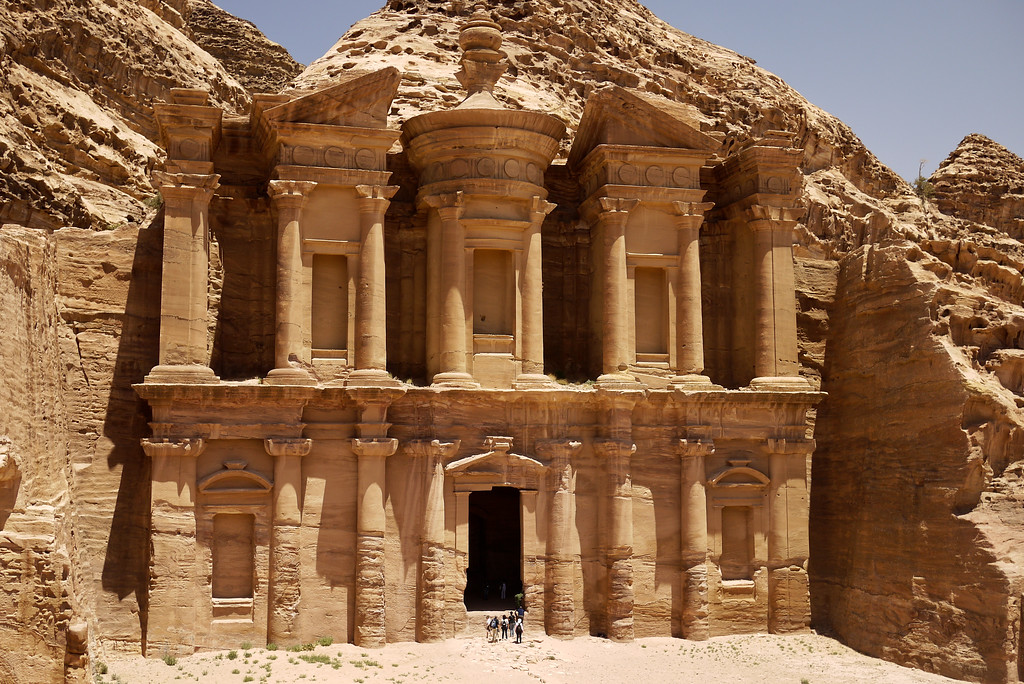
When I got to the top and saw the Monastery, Ad Deir, I was surprised by the scale. It’s enormous: almost 47 meters (154 feet) wide and 48 meters (157 feet) tall. It sits back from a natural terrace with space in front that probably hosted gatherings centuries ago. It’s less crowded and calmer than the Treasury, even when people are there.
From the Monastery, you can see how Petra’s layers come together — lower valley, upper terraces, sacred spaces distributed across different elevations. The UNESCO designation specifically cites the water system as the key to Petra’s existence: planned channels, tunnels, and cisterns that let a city of perhaps 20,000-30,000 people thrive in a desert. From above, you start to see how all the pieces connect.
The water system was the key to Petra’s existence: planned channels, tunnels, and cisterns that let a city of perhaps 20,000-30,000 people thrive in a desert. From above, you start to see how all the pieces connect.
The walk down is easier on the lungs but harder on the knees. This is the moment for lunch, shade, and water. The day isn’t over, but the hardest climb is behind you.
After resting and eating — this is a good moment for lunch and shade before continuing — I made the climb for the Treasury overlook: the photograph that’s all over Instagram.
The official, legal, safe route is the Al-Khubtha Trail, which begins behind the Urn Tomb (the first and largest of the Royal Tombs). It’s a steady uphill with no scrambling required, takes about 1.5–2 hours round trip, and leads to a balcony-style viewpoint looking directly down at the Treasury with the cliffs framing the view.
There’s sometimes a line for the exact spot. Be patient. The light in the morning or late afternoon is softer and the colors are richer. It’s worth the wait.
Safety note: There is an unofficial ‘secret’ overlook route that involves scrambling up exposed rock through areas Petra’s authorities have explicitly closed. Some guides will point to it anyway. Skip it. The Al-Khubtha Trail gives you the exact same view. Safety and legality both point the same direction here.
By mid-afternoon I was tired, and I had already decided what I would do if that happened. Petra publishes formal options — club cars and a 4×4 transfer to the Monastery trail — with prices listed on their site. I didn’t use the transport on this trip, but I liked having the plan. You will also encounter horse and carriage rides, camel rides and even donkey rides at Petra. If you would like to take any of these, bring cash.
I skipped Petra by Night. It runs Sunday through Thursday at 8:30PM and costs 30 JD (about $42 USD). I had already seen the Treasury in quiet morning light and that was enough for me.
Off to Wadi Rum and a night in a desert camp under the stars.
Day 3 Afternoon — The Road to Wadi Rum
There’s a JETT bus from Petra to Wadi Rum that departs at 5PM and costs 15 JD (about $21 USD). But I wanted to arrive before sunset, so I arranged a transfer through my camp in Wadi Rum ahead of time. This is the move I’d recommend to every solo woman traveler: let your camp handle the transport. One contact. Confirmed pickup. No negotiating with strangers at the roadside when you’re tired and your bag is heavy.
At the Wadi Rum Visitor Center, I paid the 5 JD (about $7 USD) entry fee, used the restroom, and filled my water bottles. Then I sat in the back of a 4×4 jeep and the desert began.
Wadi Rum is 74,000 hectares — about 183,000 acres, or roughly the size of Los Angeles County — of protected desert landscape. Those numbers mean nothing until you’re inside it. The rock formations shift color as the sun drops — sand to amber to deep terracotta to red.
The camp was simple: cot-style beds in tents, blankets provided, a common area around a fire where dinner appeared after dark. The meal was rice, vegetables, and lamb cooked in an underground zarb oven — slow, smoky, good. Guests ate on low cushions and then just sat there, sometimes chatting, sometimes soaking in the quiet of the desert wind, because there was nothing else to do and nowhere else to be, and the sky had taken over entirely.
Wadi Rum has almost no light pollution. Billions of stars.
I’m not exaggerating. Billions and billions.
OK, maybe slightly less. I lost count.
I lay on my back outside for a long time and felt, very precisely, how small I was in the best possible way.
Day 4 — Wadi Rum at Sunrise, Then the Road Back to Amman
We left just after sunrise for a half-day jeep route after a light breakfast of bread, tea, and dates. The morning light on the sandstone is different from anything you’ll see in full daylight — cooler tones, longer shadows, the rocks looking almost purple before the sun gets high. Bring your camera. Bring more storage than you think you need.
Distances are deceptive. Something that looks close takes longer than you’d think to reach. The driver moved between formations at speed but was unhurried about the time spent at each stop, and I was glad for the pace and how it allowed for walking around and noticing the details.
What surprised me most in Wadi Rum was the sheer number and variety of inscriptions. UNESCO recognizes around 25,000 rock carvings and 20,000 inscriptions throughout the reserve. Some mark ancient routes. Some depict animals and people. Some represent early stages of alphabet development. Humans lived or passed through here for at least 12,000 years. At times, I had to think about how someone stood exactly here and made this carving, and wondered how they decided it mattered enough to put in the work.
By late morning the light had flattened, heat kicked in, and 4x4s headed back to the Visitor Center. From there, JETT lists buses to Aqaba, Petra, and Amman are all lined up waiting, and tickets can be purchased right at the visitor center. Aqaba is under an hour by road, Amman about four hours. I took the bus to Amman. One more night in the city before flying home.
Day 5 — The Morning of Departure — Amman’s Citadel, Rainbow Street, and One Last Plate of Falafel
I had one final morning before my flight and used every minute of it. My first stop was the Citadel — Jebel Al Qala’a — which sits on the highest hill in Amman, about 850 meters (2,790 feet) above sea level. I took an Uber there for under 2 JD (roughly $3 USD). The loop around the ruins is one of those places where you can walk through three major civilizations in about 20 minutes.
First the Umayyad Palace, 8th century, Islamic architecture with wide views over the whole city. Then the Byzantine Church ruins — mosaic floors, broken columns, early Christian presence on a hill that was sacred long before Christianity arrived. Then the Temple of Hercules: massive Roman columns, visible from across the city, one of the strongest examples of Roman engineering still standing in Jordan. There are also small displays with artifacts from the Bronze Age through the Roman period that help anchor the timeline. Roman, Byzantine, Umayyad — all in roughly 45 minutes, on foot! The circuit is about 3 kilometers (nearly 2 miles) if you include the walk down toward the Roman Theater, though the Citadel itself is compact. I kept stopping just to look at the view over downtown Amman and the surrounding hills.
After the loop it was time to find souvenirs. Off to Jabal Amman.
On Fridays, this area hosts the Souk Jara, a seasonal open-air market. It operates Fridays from 10AM to 10PM, May through November, with food stalls, local vendors, and live performances. It wasn’t open during my visit, which was disappointing. But I found a handful of shops right on Rainbow Street selling locally-made textiles, ceramics, and Bedouin-style crafts — Urdon Shop and Bedouin Spirit were both worth a wander. For another option with what I’m told has a similar feel, the Old Souk in downtown Amman is worth knowing about. And if you’re visiting Amman on a Saturday, there’s the Nour al-Barakah Saturday Market, and a farmers’ market on Arar Street.
At the recommendation of my guide in Petra, I grabbed a quick lunch at Hashem Restaurant in downtown Amman — fast, cheap, central, and famous for good reason. The falafel is crispy on the outside and perfectly spiced inside. The hummus is creamy and served warm. A plate of each costs almost nothing.
I ate too much and didn’t regret a bite.
Hashem’s falafel is crispy on the outside and perfectly spiced inside. I ate too much and didn’t regret a bite.
A few things I’d tell a friend going solo to Jordan…
Jordan is genuinely welcoming to solo women travelers. These practical notes shaped my experience in ways that made a real difference.
Use official channels: In Petra, I booked a licensed guide at the Visitor Center — available right there on arrival, at posted prices, which meant no haggling deeper in the site. In Wadi Rum, I booked through my camp and let them manage transport and the jeep tour. Both decisions matched official guidance and made every logistical moment clean. The Visit Petra site is run by the government and has the latest ticket prices, as well as tips to stay safe when you’re there.
Know your transport options before you need them: Petra publishes prices for club cars and the 4×4 transfer to the Monastery trail on their official site. Looking this up in advance meant I could make decisions when I was tired without stress or negotiation.
Plan your water and facilities like a constraint, not an afterthought: Petra has restrooms just past the Treasury, refreshment stands along the main trail, and a larger restaurant and restrooms in the basin area. Wadi Rum has no facilities inside the reserve at all. Arrive with more water than you think you need. Both times.
Dress for function AND modesty: In Petra, I wore a light cotton shalwar kameez — hip-length tunic and flowy pants that gather at the ankle. It was light enough for the heat and covered enough for the terrain and local norms. In Wadi Rum, loose layers covering arms and legs all day, with a light scarf that doubled as sun and wind protection. At night, add a warm layer. Desert temperatures drop fast.
On clothing in Amman: Dress like a local professional on a relaxed day. Loose pants or midi skirt, sleeves, nothing tight or low-cut. You don’t need to cover your hair. You’ll stand out less for modesty than for showing skin in a desert climate. And shoes matter — you will be walking a lot, and the ground can be uneven. Leave the heels for Hollywood and opt for structure and comfort.
Travel Insurance: Yes, I always recommend getting travel insurance, particularly when heat exhaustion and dehydration are common. I’m a fan of Allianz for price, customer service, and comprehensive coverage.
The Numbers, Plain and Simple
Petra entry: 50 JD (~$70 USD) for one day, 55 JD (~$78 USD) for two days, 60 JD (~$85 USD) for three days. The Jordan Pass (70–80 JD, or roughly $99–$113 USD, depending on how many Petra days you include) covers Petra entry, Wadi Rum entry, and waives the visa fee if you arrive by air and stay at least three nights. If you’re combining both sites, do the math — the Pass usually wins.
Wadi Rum entry: 5 JD (~$7 USD) at the Visitor Center.
Bedouin cultural tents near Petra entrance: 2 JD (~$3 USD).
JETT bus, Petra to Wadi Rum: 15 JD (~$21 USD). JETT bus, Wadi Rum to Amman: approximately 4 hours.
Petra by Night runs Sunday through Thursday at 8:30PM for 30 JD (~$42 USD). I skipped it — I had already seen the Treasury in quiet morning light and that was enough. But if evening atmosphere is your thing, it’s there.
Note: JD to USD conversions above are approximate, based on current exchange rates. Confirm rates before your trip.
What this trip is, really.
The rhythm of this itinerary — city, then ancient carved city, then open desert — is not accidental.
Amman anchors you in modern Jordan. Petra puts you inside a civilization that mastered water in the desert and carved its identity into rock. Wadi Rum strips everything back to geology and sky and the long human record scratched into stone. Each place makes the others make more sense.
Give Petra two days. Walk slowly through the Siq every time. Take the Wadi Farasa loop. Climb to the Monastery. Earn the overlook photo.
Stay one night in Wadi Rum. Watch the sunset. Lie on your back and count stars until you lose count. Let the silence be the point.
Then go back to Amman. Take in more history. Interact with the modern locals. Eat falafel. Walk Rainbow Street. Sit somewhere with tea and let the trip settle.
I went to Jordan curious and came home changed. I hope you do too.
Books Before Boarding
Jordan is one of those destinations that reveals itself in layers — and how much you see often depends on what you already know when you arrive. The architecture at Petra is extraordinary on its own terms, but it becomes something else entirely when you understand who built it and why. The Bedouin hospitality you’ll encounter in Wadi Rum has a texture and a history behind it that changes how you receive it. The women you meet in Amman — wearing abayas, or jeans, and everything in between — are living inside a culture with deep and complicated roots. Reading before you go allows you to arrive with a little more context. These five books are a good place to start.
Petra: Jordan’s Extraordinary Ancient City by Fabio Bourbon
If you want to know what you’re looking at before you step into Petra’s canyon, this is the book to have. It covers every major monument in detail — from the Treasury to the Monastery — examining each in relation to the complex historical and artistic story of the Rose-red City, with an introductory chapter tracing the full evolution of the site. It’s packed with practical information, splendid photographs, and dozens of plans and reconstruction drawings, and readers consistently note that the maps are excellent — covering not just whole monuments but individual architectural details. Think of it less as a coffee table book and more as a field guide you’ll wish you’d read the week before. One honest note: the writing leans toward the poetic and the perspective is heavily Western, which some readers find frustrating. But for visual orientation and architectural context, it does the job well.
Lawrence in Arabia: War, Deceit, Imperial Folly and the Making of the Modern Middle East by Scott Anderson
This is the history book for people who don’t think they like history books. In early 1914, T.E. Lawrence was an archaeologist excavating ruins in Syria; by 1917 he was riding into legend at the head of an Arab army, fighting a rearguard action against his own government and its imperial ambitions. Anderson uses Lawrence as the anchor for a much wider story — sweeping in its action, keen in its portraiture, and pointed in its condemnation of the destruction wrought by European colonial plots, capturing the way in which the folly of the past creates the anguish of the present. The Wall Street Journal called it “expansive, mesmerizing, and cinematically detailed.” For a traveler heading to Wadi Rum — the very desert where Lawrence operated — it provides the kind of historical grounding that makes the landscape feel inhabited by something larger than scenery. A finalist for the National Book Critics Circle Award in Biography.
Pillars of Salt by Fadia Faqir
This is the story of two women confined to a mental hospital in Jordan during and after the British Mandate: Maha, a peasant woman from the Jordan Valley, and Um Saad from Amman, who find themselves sharing a room. After initial tensions they become friends and exchange their life stories. Faqir interweaves ancient Arabic storytelling traditions with Muslim and Christian theological sources to capture an alternative picture of Jordanian history — specifically the lives of women whose daily contributions are rendered invisible in a male-dominated society. What makes this book particularly valuable for a solo woman traveler is that it comes from inside: Faqir was born in Amman in 1956, and her work is recognized for its stylistic invention and its unflinching honesty about Third World women’s lives, migration, and cultural in-betweenness. It won’t give you a comfortable or simple picture of the country, but it will give you a real one — and that’s worth more.
Married to a Bedouin by Marguerite van Geldermalsen
This is the one I’d hand to any solo woman traveler first. In 1978, Marguerite van Geldermalsen — a New Zealand nurse — met Mohammad, a souvenir-seller born in a Petra cave, and stayed. What began as a traveler’s adventure became a lifelong immersion into Bedouin life. She lived with him in a two-thousand-year-old cave carved into the red rock of a hillside, became the resident nurse for the tribe, and learned to live like the Bedouin: cooking over fires, hauling water on donkeys, and drinking sweet black tea. In 1985, when the Bedouin were resettled to the village of Umm Sayhoon on a hillside overlooking Petra, she moved too — no longer an outsider, but part of the tribe. The book is warm, specific, and deeply human. It shows you Petra not as tourists see it, but as it is lived. And there’s one more reason to love it: Marguerite has been known to appear in person at a souvenir shop along the main path through the site, where she signs copies for visitors. If you’re lucky enough to find her there, stop. Buy the book. Have her sign it.
Jordan: Walks, Treks, Caves, Climbs, and Canyons by Tony Howard and Di Taylor
For anyone who wants to go deeper into Petra or spend more time on foot in Wadi Rum, this is the practical guide to have. Howard and Taylor were responsible for the discovery in 1984 of Wadi Rum as a climbing and trekking area, and have returned to Jordan almost every year since, documenting routes across the country — from Pella and Ajloun to the Dead Sea Hills, Dana, Petra, and Wadi Rum. The book describes 150 routes: half-day to multi-day treks, 30 canyon routes, 5 climbing areas, and 24 desert and mountain walks in Wadi Rum. It was also Howard and Taylor who had the original idea in the late 1990s for what became the 650-kilometer Jordan Trail in 2016. This is less pre-trip reading and more pre-trip planning — the book for someone who has already decided to go and wants to figure out exactly where their feet are going to take them.